FREE TOOL · SAROKEY FIELD GUIDE NO. 01

The 2026 Kitchen
& Bath Planning Guide.

A clear, practical guide to planning your remodel in Northern Virginia — budgets, design choices and what to expect along the way.

  • 11 chapters
  • 14 pages
  • Read in about ten minutes
  • Free PDF

Answer the twelve questions in chapter eleven and you will be better prepared than most homeowners ever are. If you would rather talk it through, we are ten minutes away in Fairfax.

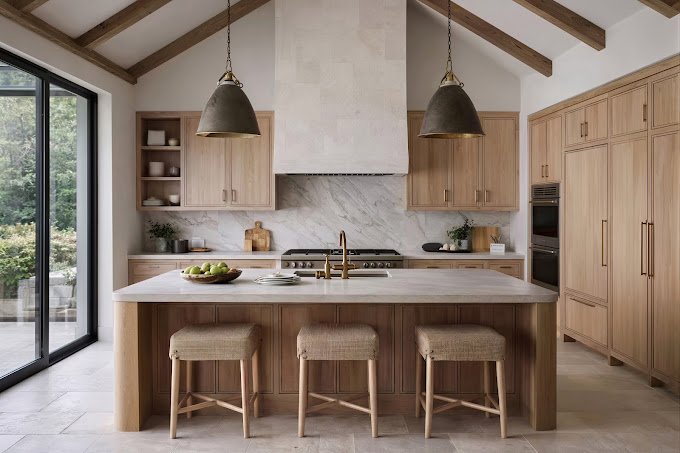
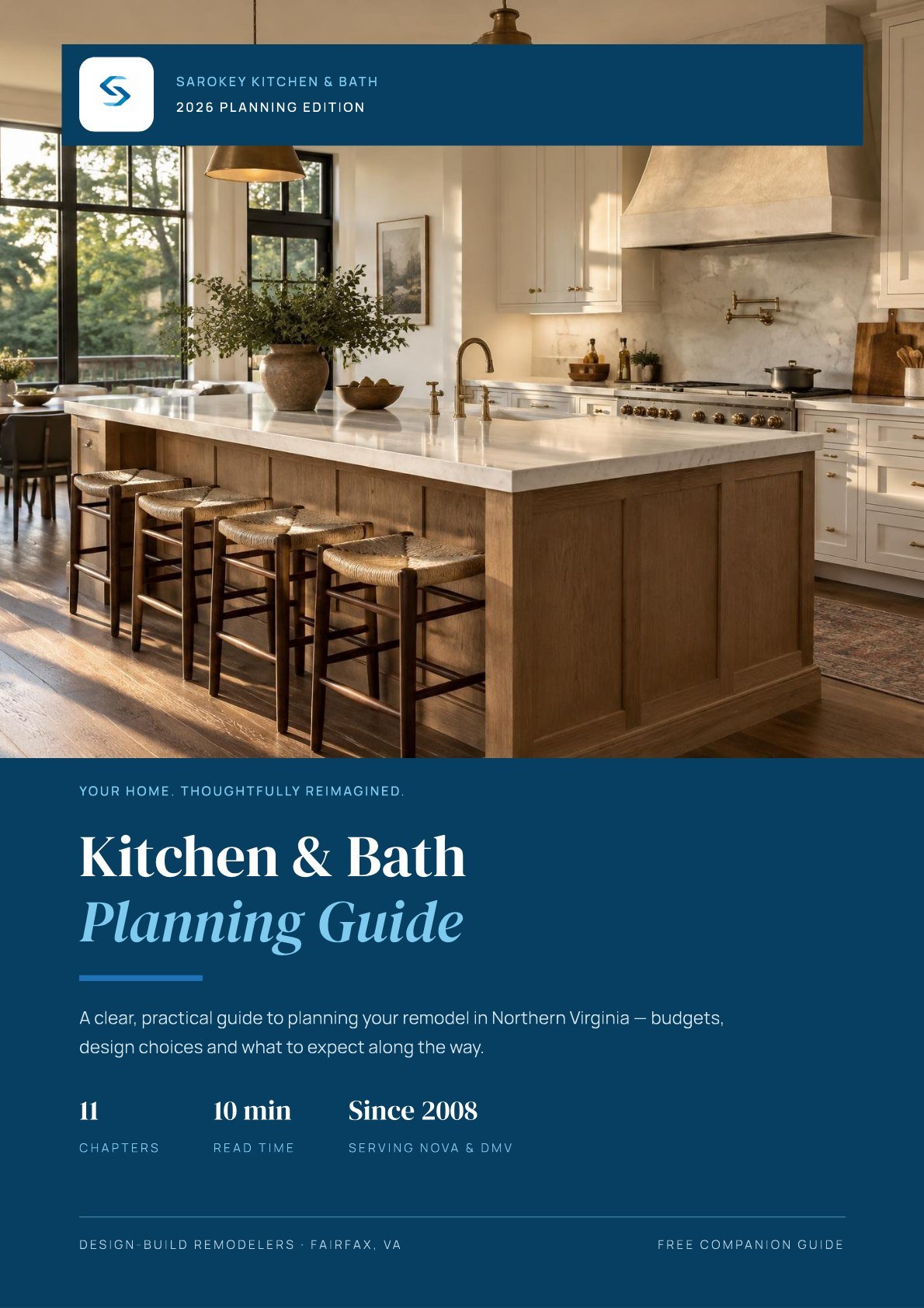
Cover of the 2026 Sarokey Kitchen and Bath Planning Guide: Your home. Thoughtfully reimagined.
Get the free guideTell us where to send it. No cost, no catch.
We use your details only to send the guide and to answer your questions. See our privacy notice.

Prefer a printed copy? Ask for one at your consultation — we keep a stack on the studio table. Book a free consultation.

WHAT’S INSIDE

Eleven chapters, one afternoon of planning.

Read straight through, or jump to the chapter that matches the question you are asking this week. Every chapter works on its own.

  1. 01Five questions to answer before you call a contractor.
  2. 02What a kitchen actually costs in NoVa in 2026.
  3. 03What a bathroom actually costs in NoVa in 2026.
  4. 04Where to save. Where to splurge.
  5. 05Cabinets 101: stock, semi-custom, custom.
  6. 06Countertops without the confusion.
  7. 07The real timeline: what happens, when.
  8. 08Permits and inspections across NoVa.
  9. 09Living through a remodel without losing your mind.
  10. 10Red flags in contractor bids.
  11. 11Questions to ask before you sign.
Chapter 01

Five questions to answer before you call a contractor.

The single biggest predictor of a smooth remodel isn’t the contractor you pick — it’s how clearly you’ve defined the project in your own head before anyone else gets involved. Spend an hour with these five questions on a Sunday morning. It’s the highest-return hour of the whole project.
  1. 01
    Why now?

    Are you fixing a real problem — a bath that leaks, a kitchen that doesn’t work for how you cook — or chasing a vision? Both are valid, but they lead to different budgets. Fixing-a-problem projects tend to expand mid-build. Vision projects tend to over-scope from day one. Naming which one you’re doing keeps you honest.

  2. 02
    What is the actual budget?

    Not what you’d like to spend — what you’re willing to spend, including a 10% contingency for surprises behind the walls. Write down two numbers: a “hopeful” number and a “walk-away” number. The gap is your negotiating room.

  3. 03
    What is the timeline pressure?

    Holidays coming up? Baby on the way? Selling in the spring? Timeline pressure changes decisions — it may push you toward stock cabinets instead of custom (6 weeks versus 14), or force a phased build. Say it out loud early.

  4. 04
    What are your three must-haves?

    Not fifteen. Three. If your primary bath must have a curbless shower, a double vanity and heated floors, everything else is negotiable when budget gets tight. Contractors love clarity here.

  5. 05
    What are your two deal-breakers?

    The things you will absolutely not compromise on — including process things. “I won’t work with a contractor who uses subs for tile.” “I won’t sign a cost-plus contract.” Deal-breakers filter contractors faster than anything in their portfolio.

The best remodels start on paper, not on Pinterest. Twenty minutes of honesty with yourself will save you twenty thousand in change orders.

Sarokey design team
Chapter 02

What a kitchen actually costs in NoVa in 2026.

National averages are useless. Northern Virginia labour, permit costs and material supply chains put us meaningfully above the U.S. median. Here’s what we’re actually quoting today for kitchens in Fairfax, Arlington, Loudoun, Alexandria and the greater DMV — for an average 180 sq ft kitchen footprint.

TierScopeAll-in range
RefreshNew countertops, hardware, backsplash, paint, appliance swap. Cabinets stay.$18k – $35k
Mid-range remodelNew semi-custom cabinets, quartz counters, mid-tier appliances, tile floor, lighting, minor layout changes.$55k – $95k
Full remodelWall removal, custom cabinetry, premium stone, higher-end appliances (Bosch, Thermador, Café), new flooring throughout.$95k – $180k
Luxury / gutStructural changes, panel-ready pro appliances (Sub-Zero, Wolf, Miele), stone slabs, custom millwork, integrated lighting design.$180k – $400k+

All-in figures include design, materials, labour, permits and Sarokey’s project management. Major structural or MEP surprises are excluded.

Where the money actually goes

For a mid-range remodel, here’s the dollar split — useful when evaluating a line-item bid.

Line item% of budgetMid-range dollars
Cabinets and installation30 – 40%$22k – $30k
Countertops (stone + install)10 – 15%$6k – $12k
Appliances10 – 15%$6k – $12k
Labour (demo, plumbing, electrical, tile, paint)20 – 25%$14k – $22k
Fixtures, hardware, lighting5 – 8%$3k – $6k
Design fees, permits, project management10 – 15%$6k – $12k
Chapter 03

What a bathroom actually costs in NoVa in 2026.

Bathrooms are smaller than kitchens, but per square foot they’re often more expensive — waterproofing, plumbing reroutes and tile labour pile up fast. Here’s the real range across the three most common bath projects.

Powder room

TierScopeAll-in range
RefreshNew vanity, toilet, mirror, lighting and paint. Same layout.$6k – $12k
Full remodelNew tile floor, custom vanity, statement lighting, wallpaper or wainscoting, plumbing rough-in changes.$14k – $28k

Hall or secondary bath

TierScopeAll-in range
MidTub-to-shower conversion or tub refit, new tile, vanity, fixtures, paint.$22k – $38k
FullLayout changes, custom vanity, quartz top, tile floor and walls, glass shower enclosure, upgraded fixtures.$38k – $65k

Primary bath

TierScopeAll-in range
Full remodelCurbless shower, double vanity, freestanding tub, tiled floor and walls, heated floors, quartz or quartzite.$55k – $95k
Luxury suiteSteam shower, wet-room configuration, natural stone slabs, statement millwork, closet integration, lighting scenes.$95k – $200k+
Chapter 04

Where to save. Where to splurge.

Almost every remodel goes over budget because homeowners spend evenly across every line item. The clients who stay on budget do the opposite: they cut hard in a few places so they can go big in others.

Save on these

  • Cabinet interiors. Nobody sees inside your drawers. Semi-custom boxes with custom fronts get you 90% of the look at 60% of the price.
  • Trend finishes on visible metal. Faucets and pulls date faster than anything else. Buy the mid-tier version now and re-swap in eight years.
  • Recessed can lighting. A can is a can. Spend on the fixtures people see.
  • Standard-size vanities. 24", 30" and 36" bases are dramatically cheaper than “just make it 34 inches to fit”.
  • Backsplash tile. A great $8/sf ceramic in a great pattern beats a boring $28/sf stone every time.
  • Second-tier appliance brands. Bosch, KitchenAid and Café hit 90% of Wolf and Sub-Zero for half the price.

Splurge on these

  • Cabinet hinges and slides. Blum, Grass, Salice. This is what makes a kitchen feel expensive when you open a drawer.
  • The kitchen faucet. You touch it forty times a day. Buy the one that will still feel right in ten years.
  • Under-cabinet lighting. The single highest-impact upgrade per dollar in any kitchen.
  • Waterproofing in showers. Schluter Kerdi or equivalent. Cutting corners here is how you gut a bath twice in ten years.
  • Countertop thickness and edge. A 3cm mitred edge reads custom. A 2cm eased edge reads flip.
  • Vent hood CFM. Undersized hoods are the number one kitchen complaint we hear on year-two follow-ups.
Chapter 05

Cabinets 101: stock, semi-custom, custom.

Cabinets are the single biggest line item in almost every kitchen. They’re also the most confusing: three tiers, three completely different lead times, and about a four-times spread in cost from bottom to top.

TypeSizesLead timeCost / linear ft
StockFixed increments (3", 6", 9"…)2–4 weeks$150 – $350
Semi-customSome size and door flexibility6–10 weeks$350 – $700
CustomAny dimension, any door, any finish10–16 weeks$700 – $1,400+

What actually matters

Homeowners obsess about door styles. Cabinet-makers know the door is the least important part. Here’s what separates a great cabinet from a mediocre one, in order.

  1. Box construction. Full plywood beats particleboard every time. Ask for 3/4" ply sides and dovetailed drawers.
  2. Hardware quality. Soft-close hinges from Blum or Grass, full-extension undermount slides. Non-negotiable.
  3. Finish process. A conversion-varnish or catalysed finish will look right in ten years. Water-based lacquer will not.
  4. Door construction. Solid wood rails and stiles; MDF panel is fine for paint-grade. Solid wood panels on stained cabinets.
  5. Then door style. Shaker, slab, inset, beaded — a matter of taste, priced accordingly.
Chapter 06

Countertops without the confusion.

Stone shopping is where most homeowners lose their footing — showrooms are overwhelming, salespeople push exotic slabs, and the price differences don’t match the durability differences. Here’s what you need to know about the five materials that actually matter.

MaterialLookDurabilityCareInstalled / sq ft
Quartz (engineered)Any patternExcellentNone$70 – $120
Quartzite (natural)Marble-like veiningExcellentAnnual seal$120 – $220
MarbleThe classicEtches and stainsFrequent seal$95 – $250
GraniteSpeckled, dramaticExcellentAnnual seal$65 – $140
Butcher blockWarm, workableScratches, dentsOil quarterly$50 – $95

The honest answer to “what should I pick?”

For eight out of ten kitchens we recommend a good quartz — indistinguishable from natural stone at a distance of three feet, zero maintenance, no anxiety about your kids doing homework on it with a leaky pen. Save the natural stone for the island or a statement powder room where it can be dramatic without being punished daily.

Edges and thickness

  • 3cm over 2cm. Thicker stone reads custom. On perimeter runs, 3cm is worth the small upcharge.
  • Mitred edge. An extra inch or two of stone mitred to the top creates a thick look without buying thick stone. Modern, custom-feeling, minor cost.
  • Skip ogee. Ornate edge profiles date faster than anything on this list. Eased or square are timeless.

In a 2026 kitchen, spend your stone budget on the island. Do the perimeter in a great quartz. Nobody will ever know.

Sarokey design team
Chapter 07

The real timeline: what happens, when.

Contractors quote timelines in “weeks of build”, which leaves out roughly half the calendar. Here’s the full picture — from your first call to the day the last inspector signs off — for a typical mid-range NoVa kitchen.

PhaseDuration
Consultation1 day
Design and quote1 week
Selections2 weeks
Permits2–4 weeks
Cabinet lead time6–10 weeks
Demo3–5 days
Rough plumbing and electric1 week
Cabinets and drywall1–2 weeks
Tile, stone, floors2 weeks
Trim, paint, finish1 week
Punch list and walkthrough2–3 days

Two things to know

Cabinet lead time runs in parallel with permits. That’s why the total calendar isn’t the sum of every line above — a well-run contractor is doing three things at once from week two through week twelve.

Sarokey’s build phase runs three to six weeks for most kitchens. Anything longer than eight weeks in-house is usually a sign that the contractor over-committed and is juggling jobs. Ask directly what your project’s dedicated crew count will be.

Chapter 08

Permits and inspections across NoVa.

Every NoVa jurisdiction has its own permit office, its own fee schedule and its own inspector personalities. A good contractor knows these differences cold. Here’s a quick primer on the four you’re most likely dealing with.

  • Fairfax County

    Online permit portal (PLUS). Kitchens and baths typically require building, electrical, plumbing and mechanical permits when relocating fixtures. HOAs often require separate architectural review — start that in parallel. fairfaxcounty.gov/landdevelopment

  • Arlington County

    Uses ePlan Review. Turnaround is typically faster than Fairfax (10–14 days for a simple bath or kitchen). Be prepared for stricter enforcement on load-bearing wall removals — engineered drawings are often required. arlingtonva.us/permits

  • Loudoun County

    Loudoun Online (LOLA). Similar scope to Fairfax. Historic-district rules apply in Leesburg, Middleburg and Waterford — external changes require additional review even if you’re only changing an interior window. loudoun.gov/permits

  • Alexandria and Falls Church

    Both smaller offices, both surprisingly quick. Alexandria has strict rules for Old Town historic properties. Falls Church City is separate from Fairfax County — don’t confuse the two. alexandriava.gov · fallschurchva.gov

Chapter 09

Living through a remodel without losing your mind.

The single most underestimated part of any remodel is what daily life feels like while it’s happening. Plan for that up front and you’ll get through it. Ignore it and you’ll be at the end of your rope by week two.

If your kitchen is out of commission

  • Set up a temporary kitchen — usually in the dining room. Microwave, toaster oven, electric kettle, mini-fridge, folding table, paper plates. That’s 80% of what you need.
  • Move the coffee setup somewhere quiet. Morning coffee amid demo dust is a special kind of misery.
  • Budget for takeout. Add $150–$300 a week to your remodel budget for meals you didn’t cook. Nobody warns you.

If your only bath is out of commission

  • Rent a portable or arrange with a neighbour. Yes, really.
  • Sequence the work so plumbing is offline for the shortest window possible — a competent contractor can usually get water back to a secondary bath within three to four days.
  • Consider a short-term rental for the plumbing-off week if you have children or work from home. It’s often cheaper than the stress.

Dust, noise and mental load

  • Zip-wall the work area. A well-run job site has plastic sheeting and negative-pressure fans. Ask about the dust protocol at the bid stage.
  • Establish quiet hours. If you work from home, be clear about your key meetings up front. A good crew will schedule loud work around them.
  • Children and pets: visit the site with the children on demo day (they love it). Board or day-camp pets — the noise is stressful and there’s constant traffic through doors.
  • Change orders happen in weeks three to five. Homeowners get “site-inspired” and start adding scope. Try to make those decisions in week one, or accept that they’ll extend the timeline.

The single question that shortens every remodel: “What do you need from me this week?” Ask your project manager that on Monday morning, every Monday.

Chapter 10

Red flags in contractor bids.

We’ve been on the other side of thousands of homeowner conversations that started with “our last contractor…”. Here’s the pattern-matching we’ve built up. If a bid shows any two of these, walk.

  • The number is a single lump sum with no line items

    “$78,500 for a full kitchen” tells you nothing. You need to see cabinets, stone, appliances, labour and permits broken out. Otherwise you can’t compare bids and you can’t spot where they’re padding.

  • A deposit above 25% before any work starts

    Virginia allows up to 33%; we recommend never paying more than 25% up front, with milestone-based draws thereafter. A 50% deposit means the contractor is using your money to finish somebody else’s job.

  • “Cost plus” instead of a fixed price

    Cost-plus can be legitimate on complex projects, but on a standard kitchen or bath it usually means “we’ll figure the number out as we go”. That’s how a $60k job becomes a $95k job.

  • They won’t put the timeline in writing

    “About eight weeks” isn’t a commitment. A real contract has a start date, a substantial-completion date and a completion date — with defined consequences for slippage.

  • The Class A licence or insurance can’t be verified

    Ask for the VA contractor licence number and the certificate of insurance up front. Both are verifiable in ninety seconds. If they hedge, move on.

  • Every trade is a sub, and none of them are named

    A contractor who subs out 100% of the work is a project manager, not a builder. That’s fine — but you’re paying a markup on every trade, and coordination is where projects fall apart. Ask who’s on payroll versus subcontracted.

  • No written warranty on labour and materials

    Anything less than one year on labour is unacceptable in Virginia. Materials should carry the manufacturer’s warranty, usually longer. Get it in writing before signing.

Chapter 11

Questions to ask before you sign.

Print this chapter. Take it to every contractor consultation. If they can’t answer confidently, keep looking.

  1. 01
    May I review your current insurance details?

    Ask for a current certificate of insurance and coverage details before you sign.

  2. 02
    Who on your team will be my project manager, and how do I reach them?

    You want one name, one phone number, one email. Not a receptionist.

  3. 03
    What percentage of the work is done by your own employees versus subcontractors?

    Higher in-house means better coordination and fewer finger-pointing days.

  4. 04
    Can I have a fixed-price contract with a line-item breakdown?

    If they only offer cost-plus for a standard remodel, this is not the contractor for you.

  5. 05
    What’s your written warranty on labour and materials?

    Minimum acceptable: one year on labour, plus manufacturer warranties on materials.

  6. 06
    What’s your payment schedule?

    Deposit of 25% or less, milestone-based draws, final payment on completion and punch-list closure.

  7. 07
    Who pulls the permits and manages inspections?

    Correct answer: they do, and it’s included in the bid.

  8. 08
    What is your process for change orders?

    Written approval required before work begins. In writing. Every time. No exceptions.

  9. 09
    May I visit an active job site and speak with a current client?

    Not past-client references — a current, in-progress site. This tells you everything about how they run a project.

  10. 10
    How do you protect the rest of my home during work?

    The answer should include zip walls, floor protection, dust barriers and daily cleanup.

  11. 11
    What is the substantial-completion date, and what’s the penalty for slippage?

    A date and a consequence. This is the single question that separates professionals from amateurs.

  12. 12
    What happens at the end — walkthrough, punch list, warranty activation?

    There should be a defined closeout process. If it’s vague, expect a vague ending.

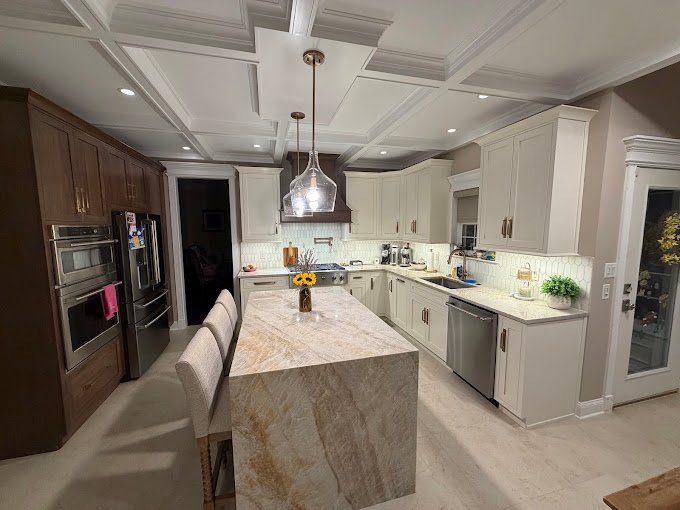
Brass pendants over a marble island
READY WHEN YOU ARE

Let’s build the next chapter of your home.

Book a free in-home design consultation and meet the designer who will personally lead your project. You’ll leave with a clear direction, a fixed-price scope, and none of the guesswork this guide was written to prevent.